Saint Lucia
Saint Lucia is a country in North America. Explore its flag and capital below — then test yourself.
- Continent
- North America
- Capital
- Castries
🧭 
Take the Saint Lucia quiz 10 questions: capital, neighbours, currency, history & more →
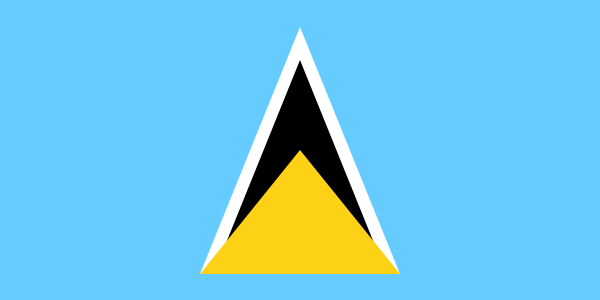
Flag of Saint Lucia See the flag, its meaning & look-alikes →
🏙 Capital: Castries Play the capital quiz →
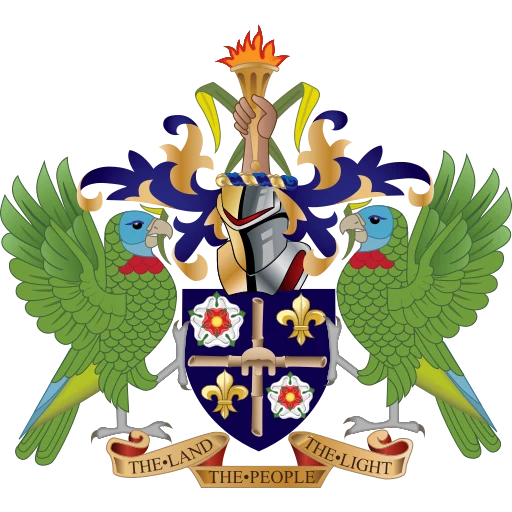
National emblem Play the coat-of-arms quiz →
Saint Lucia's flag is light blue bearing a distinctive central emblem of a golden triangle overlaid on a larger black arrowhead edged in white. The blue is the sea and sky, gold the sunshine and prosperity, and the black and white the cultural harmony of the island's peoples. The twin triangles also represent the Pitons, the iconic volcanic peaks that symbolise the nation.
Facts about Saint Lucia
- The capital of Saint Lucia is Castries.
- Saint Lucia uses the Eastern Caribbean dollar (XCD).
- Saint Lucia has about 180,149 people (2025).
- Saint Lucia covers 616 km².
- Saint Lucia became independent from the United Kingdom on 22 February 1979.
- Saint Lucia's biggest export is refined petroleum. Top exports: refined petroleum, beer and spirits.
- Official language of Saint Lucia: English.
- Largest religious group in Saint Lucia: Roman Catholic (61.5% of people).
- In Saint Lucia, people drive on the left.
- Saint Lucia has 158 km of coastline.
- Saint Lucia's system of government: parliamentary democracy under a constitutional monarchy; a Commonwealth realm.
- Saint Lucia changed hands 14 times before Britain took it for good in 1814. It is nicknamed the 'Helen of the West Indies'.
- Derek Walcott wrote the epic poem 'Omeros'. Saint Lucia also has economist Sir Arthur Lewis (1979), so it has the most Nobel laureates per person of any country.
Sources: World Bank, CIA World Factbook, Wikidata (details).
Is Saint Lucia bigger than its neighbours? Compare its population and size in Country Clash →
Play the flag quiz → Play the capital quiz →