Nigeria
Nigeria is a country in Africa. Explore its flag and capital below — then test yourself.
- Continent
- Africa
- Capital
- Abuja
🧭 
Take the Nigeria quiz 10 questions: capital, neighbours, currency, history & more →
Flag of Nigeria See the flag, its meaning & look-alikes →
🏙 Capital: Abuja Play the capital quiz →
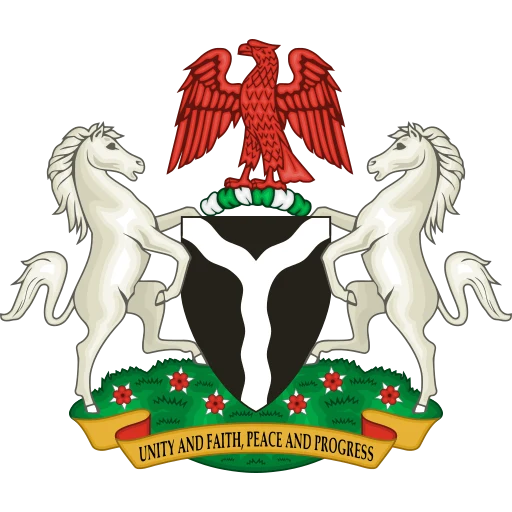
National emblem Play the coat-of-arms quiz →
Nigeria's flag has three equal vertical bands of green, white and green. Green represents the country's abundant natural wealth and forests, and white peace and unity. The clean two-colour design was the winning entry in a 1959 competition by a Nigerian student, who had included a red sun that was later removed. It was first flown at independence in 1960.
Facts about Nigeria
- The capital of Nigeria is Abuja.
- Nigeria shares a land border with Benin, Cameroon, Chad and Niger.
- Nigeria uses the Nigerian naira (NGN).
- Nigeria has about 237.5 million people (2025).
- Nigeria covers 923,768 km².
- Nigeria became independent from the United Kingdom on 1 October 1960.
- Nigeria's biggest export is crude oil. Top exports: crude oil, natural gas, gold, fertilizers and cocoa.
- Official language of Nigeria: English.
- Largest religious group in Nigeria: Muslim (53.5% of people).
- In Nigeria, people drive on the right.
- Nigeria has 853 km of coastline.
- Nigeria's system of government: federal presidential republic.
- The Kingdom of Benin, in southern Nigeria, is not the country of Benin, which was once Dahomey. Some looted Bronzes have now been returned to Nigeria.
- Olusegun Obasanjo handed power to civilians in 1979, the first Nigerian military ruler to do so. He was elected president 20 years later.
Sources: World Bank, CIA World Factbook, Wikidata (details).
Is Nigeria bigger than its neighbours? Compare its population and size in Country Clash →
Play the flag quiz → Play the capital quiz →