Namibia
Namibia is a country in Africa. Explore its flag and capital below — then test yourself.
- Continent
- Africa
- Capital
- Windhoek
🧭 
Take the Namibia quiz 10 questions: capital, neighbours, currency, history & more →
Flag of Namibia See the flag, its meaning & look-alikes →
🏙 Capital: Windhoek Play the capital quiz →
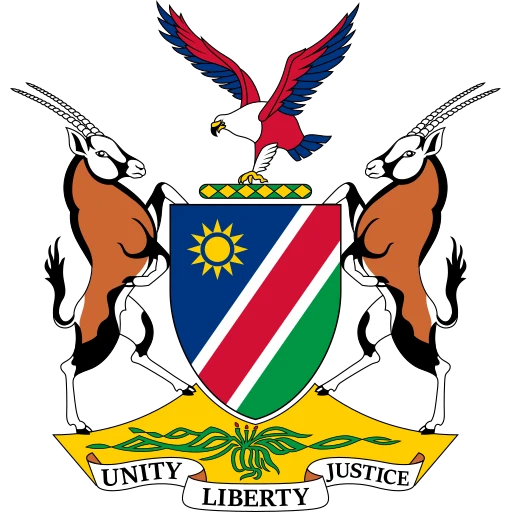
National emblem Play the coat-of-arms quiz →
Namibia's flag is divided by a red diagonal band, edged in white, running from lower hoist to upper fly, with a blue triangle bearing a golden sun above and a green triangle below. Blue is the sky and Atlantic, red the people and their determination, green vegetation, white peace and unity, and the golden sun life and energy. It dates to independence in 1990.
Facts about Namibia
- The capital of Namibia is Windhoek.
- Namibia shares a land border with Angola, Botswana, South Africa and Zambia.
- Namibia uses the Namibian dollar (NAD).
- Namibia has about 3.1 million people (2025).
- Namibia covers 824,292 km².
- Namibia became independent from South Africa on 21 March 1990.
- Namibia was once known as South-West Africa.
- Namibia's biggest export is gold. Top exports: gold, diamonds, fish and refined petroleum.
- Official language of Namibia: English.
- Largest religious group in Namibia: Christian (97.5% of people).
- In Namibia, people drive on the left.
- Namibia has 1,572 km of coastline.
- Namibia's system of government: presidential republic.
- Tens of thousands of Herero and Nama people were killed. Germany officially called it a genocide in 2021.
- Sam Nujoma led SWAPO's fight against South African rule and was president from 1990 to 2005. He died in 2025.
Sources: World Bank, CIA World Factbook, Wikidata (details).
Is Namibia bigger than its neighbours? Compare its population and size in Country Clash →
Play the flag quiz → Play the capital quiz →