Mali
Mali is a country in Africa. Explore its flag and capital below — then test yourself.
- Continent
- Africa
- Capital
- Bamako
🧭 
Take the Mali quiz 10 questions: capital, neighbours, currency, history & more →
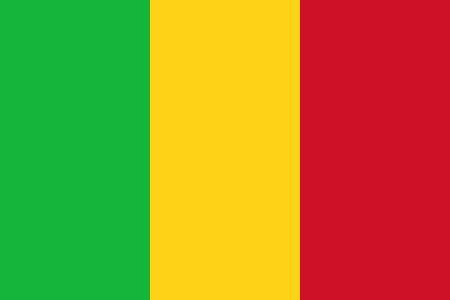
Flag of Mali See the flag, its meaning & look-alikes →
🏙 Capital: Bamako Play the capital quiz →
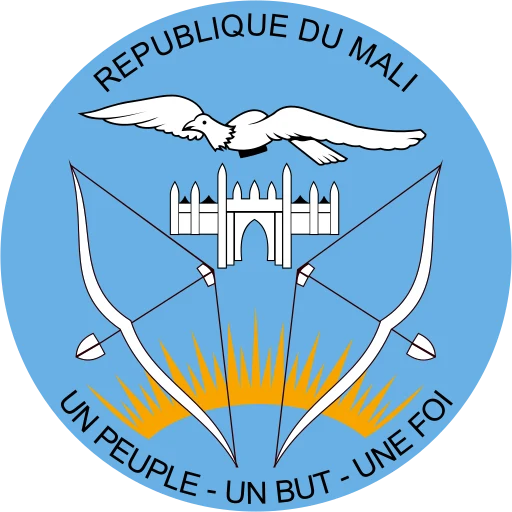
National emblem Play the coat-of-arms quiz →
Mali's flag is a vertical Pan-African tricolour of green, gold and red. Green represents the land, its fields and hope, gold the country's mineral wealth and purity, and red the blood shed for independence. The colours follow the Pan-African standard set by Ghana. Adopted in 1961, an earlier version briefly carried a black human figure ('kanaga') in the centre.
Facts about Mali
- The capital of Mali is Bamako.
- Mali shares a land border with Algeria, Burkina Faso, Guinea, Ivory Coast, Mauritania, Niger and Senegal.
- Mali uses the West African CFA franc (XOF).
- Mali has about 25.2 million people (2025).
- Mali covers 1,240,192 km².
- Mali became independent from France on 22 September 1960.
- Mali was once known as French Sudan.
- Mali's biggest export is gold. Top exports: gold, cotton and fertilizers.
- Official language of Mali: Bambara.
- Largest religious group in Mali: Muslim (93.9% of people).
- In Mali, people drive on the right.
- Mali is landlocked: it has no coastline at all.
- Mali's system of government: semi-presidential republic.
- Timbuktu flourished in the 1300s–1500s. Its manuscripts and Djinguereber mosque made it a legend of wealth and scholarship.
- Mansa Musa gave away so much gold on his way through Cairo that its value fell there for years. He had mosques built in Timbuktu.
Sources: World Bank, CIA World Factbook, Wikidata (details).
Is Mali bigger than its neighbours? Compare its population and size in Country Clash →
Play the flag quiz → Play the capital quiz →