Ivory Coast
Ivory Coast is a country in Africa. Explore its flag and capital below — then test yourself.
- Continent
- Africa
- Capital
- Yamoussoukro
🧭 
Take the Ivory Coast quiz 10 questions: capital, neighbours, currency, history & more →
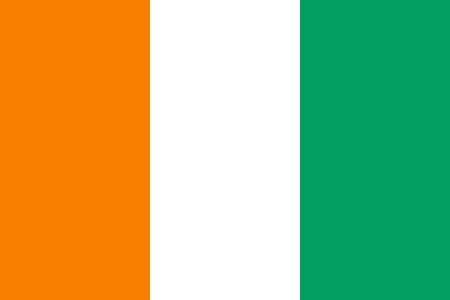
Flag of Ivory Coast See the flag, its meaning & look-alikes →
🏙 Capital: Yamoussoukro Play the capital quiz →
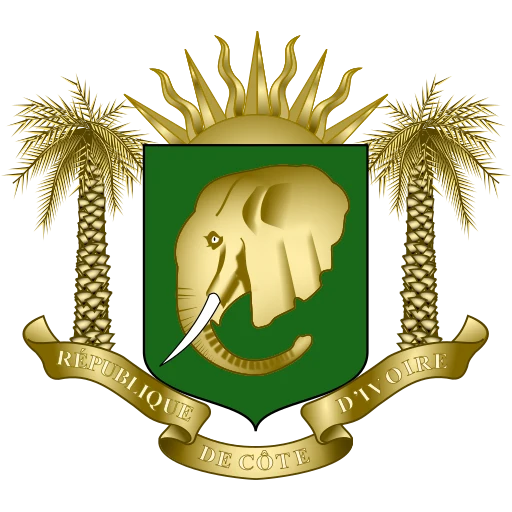
National emblem Play the coat-of-arms quiz →
Ivory Coast's flag (Côte d'Ivoire) is a vertical tricolour of orange, white and green. Orange represents the savannah lands of the north and national growth, white peace and unity, and green the forests of the south and hope. It resembles Ireland's flag but with reversed colours and different proportions. It was adopted at independence in 1960.
Facts about Ivory Coast
- The capital of Ivory Coast is Yamoussoukro. Abidjan is the economic capital.
- Ivory Coast shares a land border with Burkina Faso, Ghana, Guinea, Liberia and Mali.
- Ivory Coast uses the West African CFA franc (XOF).
- Ivory Coast has about 32.7 million people (2025).
- Ivory Coast covers 322,463 km².
- Ivory Coast became independent from France on 7 August 1960.
- Ivory Coast's biggest export is gold. Top exports: gold, cocoa, rubber, refined petroleum and cashews and coconuts.
- Official language of Ivory Coast: French.
- Largest religious group in Ivory Coast: Muslim (42.9% of people).
- In Ivory Coast, people drive on the right.
- Ivory Coast has 515 km of coastline.
- Ivory Coast's system of government: presidential republic.
- After Ivory Coast qualified for the 2006 World Cup, Didier Drogba knelt with his teammates and begged both sides to lay down their weapons.
- Félix Houphouët-Boigny ruled from 1960 to 1993. His home village later became the capital, and its basilica is one of the world's largest churches.
Sources: World Bank, CIA World Factbook, Wikidata (details).
Is Ivory Coast bigger than its neighbours? Compare its population and size in Country Clash →
Play the flag quiz → Play the capital quiz →