Guinea-Bissau
Guinea-Bissau is a country in Africa. Explore its flag and capital below — then test yourself.
- Continent
- Africa
- Capital
- Bissau
🧭 
Take the Guinea-Bissau quiz 10 questions: capital, neighbours, currency, history & more →
Flag of Guinea-Bissau See the flag, its meaning & look-alikes →
🏙 Capital: Bissau Play the capital quiz →
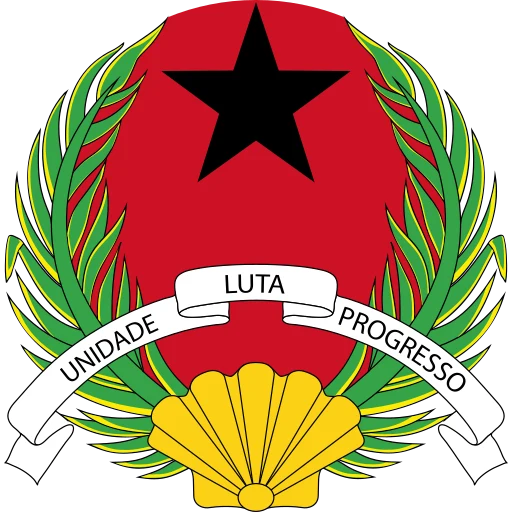
National emblem Play the coat-of-arms quiz →
Guinea-Bissau's flag has a red vertical band at the hoist bearing a black star, with horizontal yellow and green bands to the fly. Red stands for the blood of the independence struggle, yellow for the sun and harvest, and green for the land and hope. The black star is the Pan-African star of unity. The design derives from the flag of the PAIGC liberation movement.
Facts about Guinea-Bissau
- The capital of Guinea-Bissau is Bissau.
- Guinea-Bissau shares a land border with Guinea and Senegal.
- Guinea-Bissau uses the West African CFA franc (XOF).
- Guinea-Bissau has about 2.2 million people (2025).
- Guinea-Bissau covers 36,125 km².
- Guinea-Bissau's biggest export is cashews and coconuts. Top exports: cashews and coconuts, fish and fish oil.
- Official language of Guinea-Bissau: Portuguese.
- Largest religious group in Guinea-Bissau: Muslim (46.1% of people).
- In Guinea-Bissau, people drive on the right.
- Guinea-Bissau has 350 km of coastline.
- Guinea-Bissau's system of government: semi-presidential republic.
- The Carnation Revolution toppled Portugal's dictatorship in April 1974, and Portugal soon let go of its African colonies.
- Amílcar Cabral, an agronomist, founded the PAIGC independence movement. He was killed in Conakry in January 1973, and Guinea-Bissau declared independence that September.
Sources: World Bank, CIA World Factbook, Wikidata (details).
Is Guinea-Bissau bigger than its neighbours? Compare its population and size in Country Clash →
Play the flag quiz → Play the capital quiz →