Guinea
Guinea is a country in Africa. Explore its flag and capital below — then test yourself.
- Continent
- Africa
- Capital
- Conakry
🧭 
Take the Guinea quiz 10 questions: capital, neighbours, currency, history & more →
Flag of Guinea See the flag, its meaning & look-alikes →
🏙 Capital: Conakry Play the capital quiz →
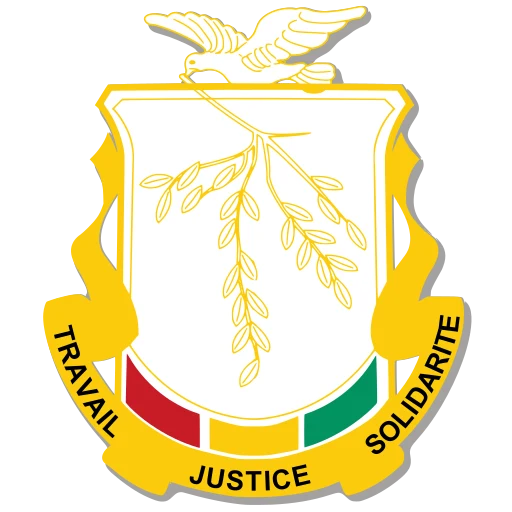
National emblem Play the coat-of-arms quiz →
Guinea's flag is a vertical Pan-African tricolour of red, yellow and green. Red represents the blood of martyrs and the labour of the people, yellow the sun, gold and the country's mineral riches, and green its vegetation and agriculture. The colours also align with the national motto 'Travail, Justice, Solidarité'. It dates to independence from France in 1958.
Facts about Guinea
- The capital of Guinea is Conakry.
- Guinea shares a land border with Guinea-Bissau, Ivory Coast, Liberia, Mali, Senegal and Sierra Leone.
- Guinea uses the Guinean franc (GNF).
- Guinea has about 15.1 million people (2025).
- Guinea covers 245,857 km².
- Guinea became independent from France on 2 October 1958.
- Guinea's biggest export is gold. Top exports: gold, bauxite, cocoa, crude oil and cashews and coconuts.
- Official language of Guinea: French.
- Largest religious group in Guinea: Muslim (85.2% of people).
- In Guinea, people drive on the right.
- Guinea has 320 km of coastline.
- Guinea's system of government: presidential republic.
- In a 1958 referendum, Guinea rejected de Gaulle's offer to join a French Community and became independent at once.
- Ahmed Sékou Touré famously told de Gaulle that Guinea preferred 'poverty in freedom to riches in slavery'. His rule became harsh and repressive.
Sources: World Bank, CIA World Factbook, Wikidata (details).
Is Guinea bigger than its neighbours? Compare its population and size in Country Clash →
Play the flag quiz → Play the capital quiz →