Greece
Greece is a country in Europe. Explore its flag and capital below — then test yourself.
- Continent
- Europe
- Capital
- Athens
🧭 
Take the Greece quiz 10 questions: capital, neighbours, currency, history & more →
Flag of Greece See the flag, its meaning & look-alikes →
🏙 Capital: Athens Play the capital quiz →
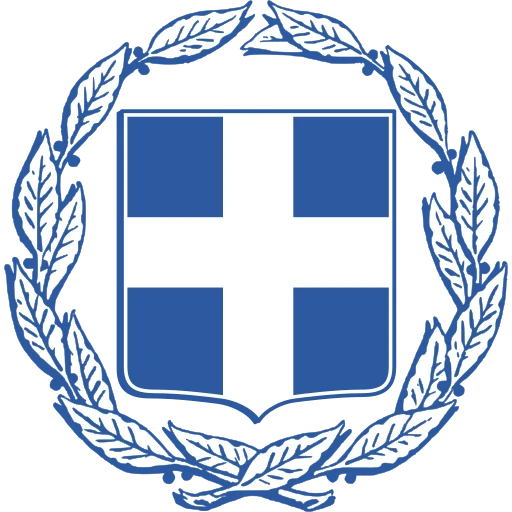
National emblem Play the coat-of-arms quiz →
Greece's flag has nine horizontal blue and white stripes with a white cross on a blue canton. The nine stripes are popularly linked to the syllables of the independence motto 'Eleftheria i Thanatos' (Freedom or Death). Blue and white evoke the sea and sky, and the cross affirms the Greek Orthodox faith central to the nation's identity.
Facts about Greece
- The capital of Greece is Athens.
- Greece shares a land border with Albania, Bulgaria, North Macedonia and Turkey.
- Greece uses the euro (EUR).
- Greece has about 10.4 million people (2025).
- Greece covers 131,957 km².
- Greece became independent from the Ottoman Empire on 3 February 1830.
- Greece's biggest export is refined petroleum. Top exports: refined petroleum, medicines, aluminium, olive oil and tobacco.
- Largest religious group in Greece: Greek Orthodox (81–90% of people).
- In Greece, people drive on the right.
- Greece has 13,676 km of coastline.
- Greece's system of government: parliamentary republic.
- Leonidas and his 300 Spartans, with a few thousand allies, held off a huge Persian army at Thermopylae for three days.
- Pericles led the city-state from about 461 to 429 BC. He championed democracy and had the Parthenon built on the Acropolis.
Sources: World Bank, CIA World Factbook, Wikidata (details).
Is Greece bigger than its neighbours? Compare its population and size in Country Clash →
Play the flag quiz → Play the capital quiz →