Burundi
Burundi is a country in Africa. Explore its flag and capital below — then test yourself.
- Continent
- Africa
- Capital
- Gitega
🧭 
Take the Burundi quiz 10 questions: capital, neighbours, currency, history & more →
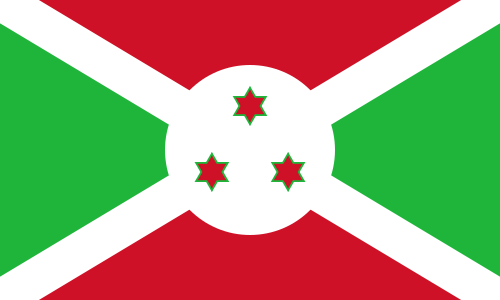
Flag of Burundi See the flag, its meaning & look-alikes →
🏙 Capital: Gitega Play the capital quiz →
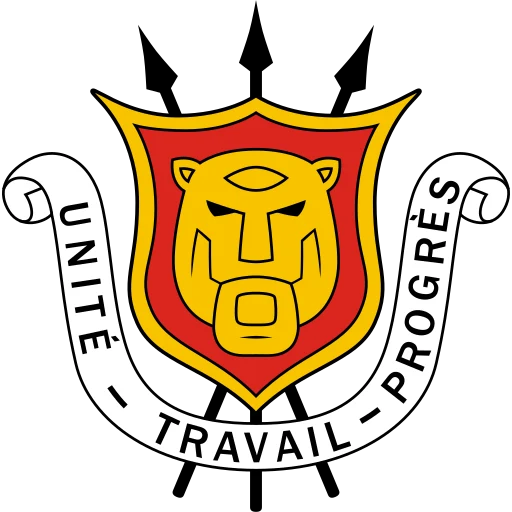
National emblem Play the coat-of-arms quiz →
Burundi's flag is divided by a white saltire into red and green fields, with a central white disc bearing three red six-pointed stars. Red recalls the suffering of independence, green hope, and white peace. The three stars stand for the national motto 'Unité, Travail, Progrès' (Unity, Work, Progress) and for the country's three main ethnic groups.
Facts about Burundi
- The capital of Burundi is Gitega. Gitega replaced Bujumbura in 2019.
- Burundi shares a land border with Rwanda, Tanzania and the Democratic Republic of the Congo.
- Burundi uses the Burundian franc (BIF).
- Burundi has about 14.4 million people (2025).
- Burundi covers 27,830 km².
- Burundi became independent from Belgium on 1 July 1962.
- Burundi's biggest export is gold. Top exports: gold, coffee, tea and tin ore.
- Official languages of Burundi: Kirundi, French and English.
- Largest religious group in Burundi: Christian (93.9% of people).
- In Burundi, people drive on the right.
- Burundi is landlocked: it has no coastline at all.
- Burundi's system of government: presidential republic.
- The war began after the assassination of Burundi's first Hutu president in 1993. About 300,000 people died.
- Pierre Nkurunziza, a former rebel leader, was elected after the civil war. His 2015 bid for a third term led to protests and a failed coup.
Sources: World Bank, CIA World Factbook, Wikidata (details).
Is Burundi bigger than its neighbours? Compare its population and size in Country Clash →
Play the flag quiz → Play the capital quiz →