Burkina Faso
Burkina Faso is a country in Africa. Explore its flag and capital below — then test yourself.
- Continent
- Africa
- Capital
- Ouagadougou
🧭 
Take the Burkina Faso quiz 10 questions: capital, neighbours, currency, history & more →
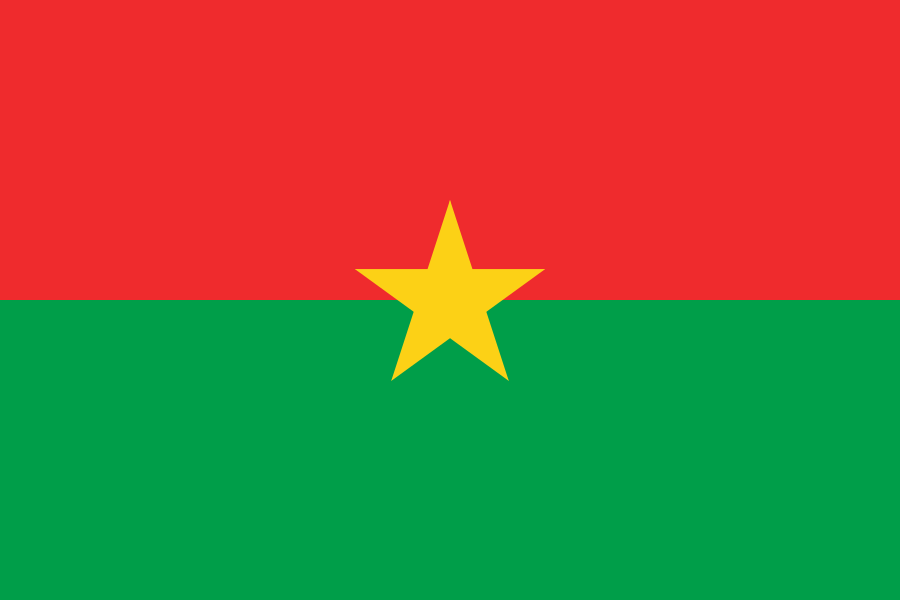
Flag of Burkina Faso See the flag, its meaning & look-alikes →
🏙 Capital: Ouagadougou Play the capital quiz →
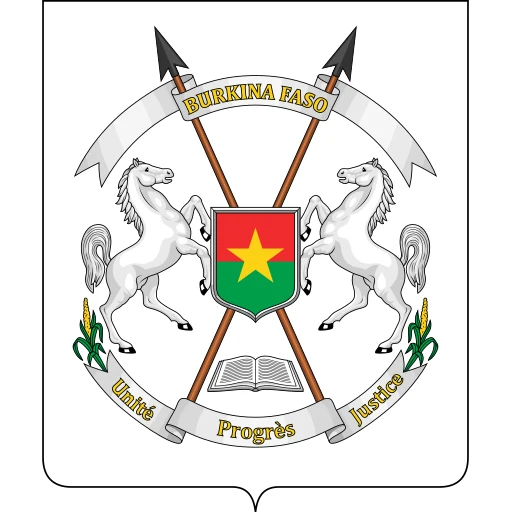
National emblem Play the coat-of-arms quiz →
Burkina Faso's flag has a red upper band and green lower band with a yellow five-pointed star centred. Red represents the revolution and blood shed for independence, green the natural riches and hope, and the golden star the guiding light of the revolution and the country's mineral wealth. It was adopted in 1984 when the country was renamed from Upper Volta.
Facts about Burkina Faso
- The capital of Burkina Faso is Ouagadougou.
- Burkina Faso shares a land border with Benin, Ghana, Ivory Coast, Mali, Niger and Togo.
- Burkina Faso uses the West African CFA franc (XOF).
- Burkina Faso has about 24.1 million people (2025).
- Burkina Faso covers 274,200 km².
- Burkina Faso became independent from France on 5 August 1960.
- Burkina Faso was once known as Upper Volta.
- Burkina Faso's biggest export is gold. Top exports: gold, cotton, cashews and coconuts and cement.
- Official language of Burkina Faso: French.
- Largest religious group in Burkina Faso: Muslim (63.8% of people).
- In Burkina Faso, people drive on the right.
- Burkina Faso is landlocked: it has no coastline at all.
- Burkina Faso's system of government: presidential republic.
- The name mixes two local languages. In Mooré, 'burkina' means upright or honest, and in Dyula, 'faso' means fatherland.
- Thomas Sankara took power in 1983, renamed the country Burkina Faso, and launched huge vaccination and literacy campaigns. He was killed aged 37.
Sources: World Bank, CIA World Factbook, Wikidata (details).
Is Burkina Faso bigger than its neighbours? Compare its population and size in Country Clash →
Play the flag quiz → Play the capital quiz →