Benin
Benin is a country in Africa. Explore its flag and capital below — then test yourself.
- Continent
- Africa
- Capital
- Porto-Novo
🧭 
Take the Benin quiz 10 questions: capital, neighbours, currency, history & more →
Flag of Benin See the flag, its meaning & look-alikes →
🏙 Capital: Porto-Novo Play the capital quiz →
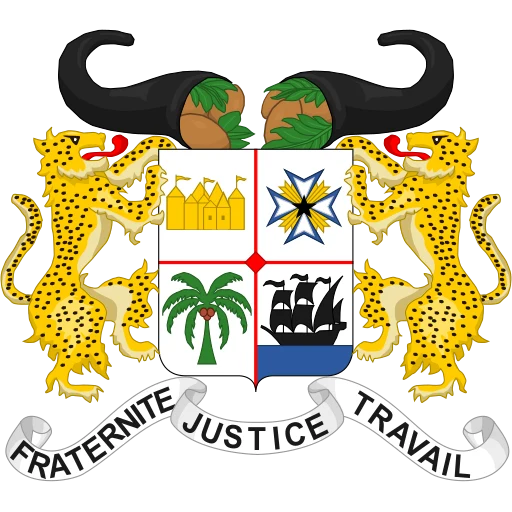
National emblem Play the coat-of-arms quiz →
Benin's flag has a vertical green band at the hoist and two horizontal bands of yellow over red. These Pan-African colours, shared with Ghana and others, carry local meaning: green for hope and the palm groves of the south, yellow for the northern savannahs and wealth, and red for the courage of ancestors. It dates from independence in 1960.
Facts about Benin
- The capital of Benin is Porto-Novo. Most ministries are in Cotonou.
- Benin shares a land border with Burkina Faso, Niger, Nigeria and Togo.
- Benin uses the West African CFA franc (XOF).
- Benin has about 14.8 million people (2025).
- Benin covers 112,622 km².
- Benin became independent from France on 1 August 1960.
- Benin was once known as Dahomey.
- Benin's biggest export is gold. Top exports: gold, cotton, cashews and coconuts, soybeans and timber.
- Official language of Benin: French.
- Largest religious group in Benin: Muslim (27.7% of people).
- In Benin, people drive on the right.
- Benin has 121 km of coastline.
- Benin's system of government: presidential republic.
- The Agojie, called 'Amazons' by Europeans, were an all-female army that fought for the kingdom from the 1600s until French conquest in the 1890s.
- Mathieu Kérékou ruled from 1972 to 1991, accepted defeat in Benin's first free elections, then won the presidency again from 1996 to 2006.
Sources: World Bank, CIA World Factbook, Wikidata (details).
Is Benin bigger than its neighbours? Compare its population and size in Country Clash →
Play the flag quiz → Play the capital quiz →