Antigua and Barbuda
Antigua and Barbuda is a country in North America. Explore its flag and capital below — then test yourself.
- Continent
- North America
- Capital
- Saint John's
🧭 
Take the Antigua and Barbuda quiz 10 questions: capital, neighbours, currency, history & more →
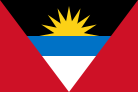
Flag of Antigua and Barbuda See the flag, its meaning & look-alikes →
🏙 Capital: Saint John's Play the capital quiz →
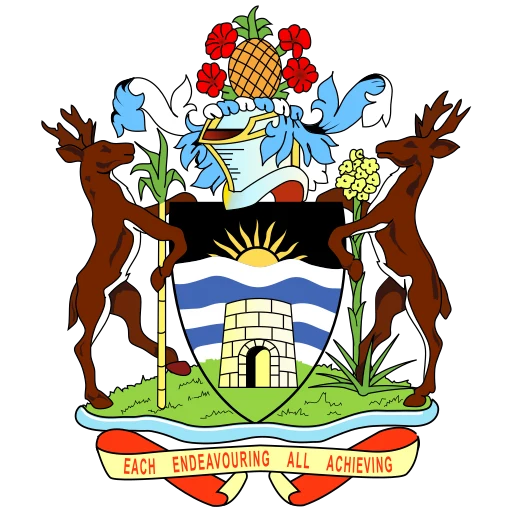
National emblem Play the coat-of-arms quiz →
Antigua and Barbuda's flag features a rising golden sun on a black band, set within red, and framed by white and blue V-shapes. The sun marks a new era, black represents the African heritage of the people, blue the Caribbean Sea and hope, and red the energy of the people. The V forms a symbol of victory. It was adopted at self-government in 1967.
Facts about Antigua and Barbuda
- The capital of Antigua and Barbuda is Saint John's.
- Antigua and Barbuda uses the Eastern Caribbean dollar (XCD).
- Antigua and Barbuda has about 94,209 people (2025).
- Antigua and Barbuda covers 443 km².
- Antigua and Barbuda became independent from the United Kingdom on 1 November 1981.
- Antigua and Barbuda's biggest export is refined petroleum. Top exports: refined petroleum, ships, soybeans, shellfish and paintings.
- Official language of Antigua and Barbuda: English.
- Largest religious group in Antigua and Barbuda: Protestant (68.3% of people).
- In Antigua and Barbuda, people drive on the left.
- Antigua and Barbuda has 153 km of coastline.
- Antigua and Barbuda's system of government: parliamentary democracy under a constitutional monarchy; a Commonwealth realm.
- Young Horatio Nelson served at English Harbour in the 1780s. Its restored naval base, Nelson's Dockyard, is a UNESCO site.
- Vere Cornwall Bird led Antigua for decades. His son Lester Bird succeeded him as prime minister in 1994.
Sources: World Bank, CIA World Factbook, Wikidata (details).
Is Antigua and Barbuda bigger than its neighbours? Compare its population and size in Country Clash →
Play the flag quiz → Play the capital quiz →